Thursday, June 2, 2011
Monday, May 30, 2011
Saturday, May 28, 2011
Friday, May 27, 2011
I was driving down the highway and I saw a very colorful tow truck at a rest-area as I was driving past. I was thinking to myself, I should get a few pictures of that. The other side of my brain said "Just keep driving, it will take to much time to stop and take pictures." I made the decision to turn around and take some pictures and was rewarded as I was able to get the above shot of which I am very pleased of the final product.
That is really how photography is. If you don't take the opportunity to take pictures, or you are too shy to get into interesting situations, you may lose the chance to capture something amazing.
Thursday, May 26, 2011
Saturday, May 21, 2011
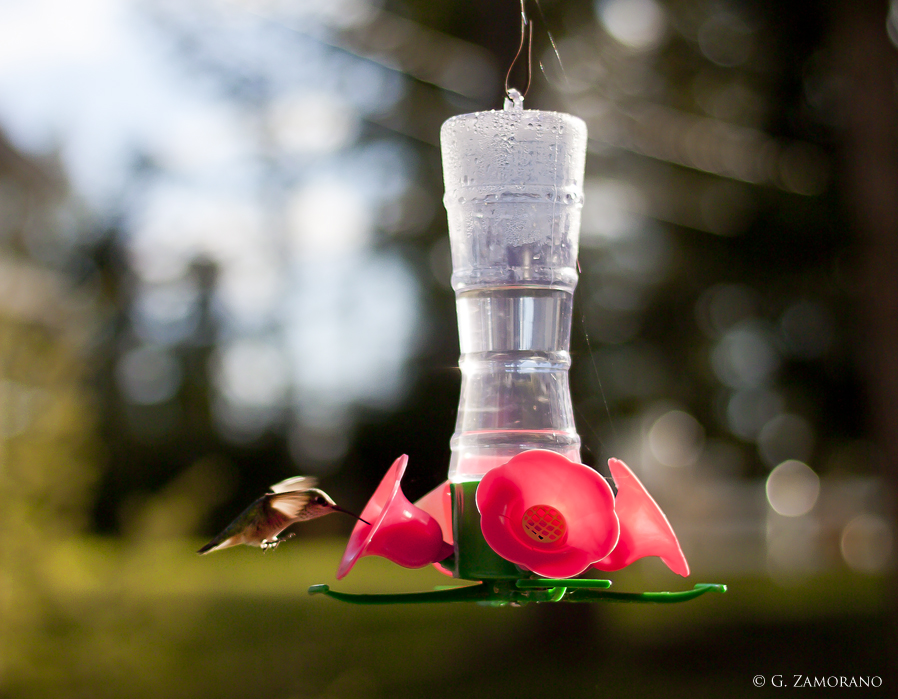
Hummingbird
I had to wait patiently and very still to get this hummingbird close enough for a decently sharp shot. I I think the first one is the best, the other two were edited quickly to show a sequence of events for fun.
I used a ridiculous 1/4000 of a second shutter speed to freeze the motion of the wings, again best demonstrated in the first photo. Well I thought that shutter speed was ridiculous until I read this article (http://www.wired.com/gadgetlab/2009/05/worlds-fastest-camera-shutter-speed-half-a-billionth-of-a-second/) which reports a shutter speed of a half billionth of a second achieved by lasers.
Friday, May 20, 2011
Fordson HDR
The above image is an HDR image of the ancient Fordson tractor I photographed on May 18, 2011. The edited result of this photograph was a lengthy process and I am not entirely pleased with the end result but I am sick today and do not have the energy to spend more time tweaking certain elements. But I will explain the process of HDR nevertheless because if used properly the images can be quite stunning. In google type in HDR under the images search and you will see what I mean.
HDR stand for "high dynamic range" which basically means that both the dark and light areas of several photographs (exact same photograph at different exposures) are combined in order to create a broad range of tones and light intensity across the entire photograph. In order to get a wide spectrum of luminance into one image you have to take 3-6 shots (6 is preferred) of the exact same picture at different exposures (amount of light that is projected onto the film or digital sensor that creates an image). The first shot will be the darkest and your last shot will be the lightest or visa-versa. For the above image I used a tripod to take 5 of the exact same shots at different exposures by setting my exposure compensation to -2, -1, 0, +1, +2 with a manually set aperture and an automatic shutter speed.
Now that I have my images I go to my PC and put them into an HDR program called Photomatix Pro which combines the pictures into one final image that has a combined broad spectrum of luminance. From there you can tone map (map one set of colors to another to create different contrast) the image to achieve your desired effect. I further edited the final tone mapped result in Photoshop to crop the image and apply noise reduction to smooth and sharpen the photo.
A lot of photographers may see this type of extreme editing and unrealistic effect as a photographic image lacking purity. I remember reading somewhere that you should spend at least 20 minutes or longer to finding the right angle or spot to a scene before you start the tedious process of HDR creation which includes finding the shot, setting up your tripod, taking shots, and editing (most time spent here). With all the time that it takes to create an HDR photo that has this unrealism added, is it worth it? I suppose the worth of the photograph is decided by the creator and the people that look at the photograph. Yes this was a bit of a tedious process but it was fun to try HDR out in order to create an alien image you would never see in "real" photography.
Thursday, May 19, 2011
I saw a beautiful colored tractor in someones "tractor graveyard" off a dirt road heading to Ruth Lake. Some ultra quick research (i.e. typing Fordson in Google) revealed this in Wikipedia.
Wikipedia
"Fordson was a brand name used on a range of mass produced general-purpose tractors manufactured by Henry Ford & Son, Inc, from 1917 until 1920 when it was merged into the Ford Motor Company, which used the name until 1964. American engineer, inventor, and businessman Henry Ford built experimental tractors from automobile components during the early 20th century..."
Wednesday, May 18, 2011
I was reading an article or forum somewhere on the internet or from one of my photography books that said (taken with a grain of salt) that in order to be a "good" photographer you have to have a balance for liking the technical side of photography and the joy of simply taking pictures or making art. The technical side of photography includes understanding how to use equipment such as len's, camera bodies, and accessories with all their associated functions. Technical aspects of photography also include post-production work such as processing film or in today's advanced world using computer software to edit photos, however this is seen as a form of art in itself for many who use these programs for their desired photographic effects. On the other hand, the art of photography is a complex connection that a photographer creates in order to make an image for what he or she sees as aesthetic. The art of photography focuses less on the equipment a photographer uses because these are simply tools needed to create a vision.
Often people are obsessed with their fancy equipment and how to be technically superb in using them. However, these people often lack artistic capabilities or vision for creating superb images. As a counter argument people could say that art is in the eye of the beholder. Unfortunately in order for art to be recognized it has to be more than just appealing to the artist but to a broad group of people from all walks of life.
It is very difficult to make an image that is technically superb but more importantly artistically engaging to people other than the creator. I suppose that is what I am striving for with my photography.
For the picture above I used Adobe Photoshop B&W control to highlight certain colors that were included in the spectrum of the photo. After adding a subtle glow this automatically gave luminance to the head lights. I really like how this turned out.
Tuesday, May 17, 2011
Relax
We all need to relax a bit more in this busy world, so take the opportunity to find that perfect park bench at sunset and breath some fresh air.
Subscribe to:
Posts (Atom)